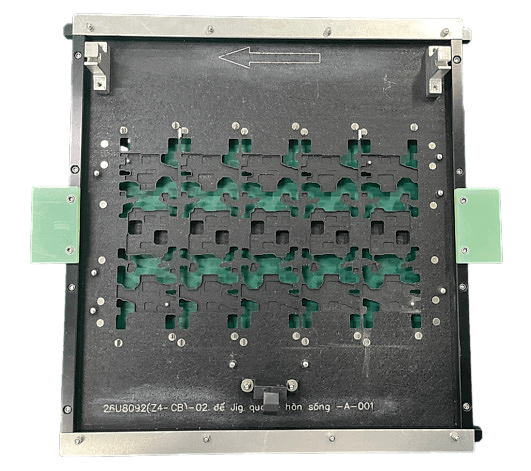
A soldering pallet — also called a solder carrier or jig — holds a PCB and its components in a fixed position through the solder process and masks the areas that must not be soldered. Get it right and you protect SMT parts and connectors while exposing exactly the joints you want; get it wrong and you scrap boards. Here's how pallets differ by process, and what makes one repeatable.
What a soldering pallet does
A pallet holds the board flat and located, masks the SMT side and sensitive components from heat and solder, exposes the through-hole joints to be soldered, and carries the board through the machine. The whole point is repeatable positioning through every thermal cycle, board after board.
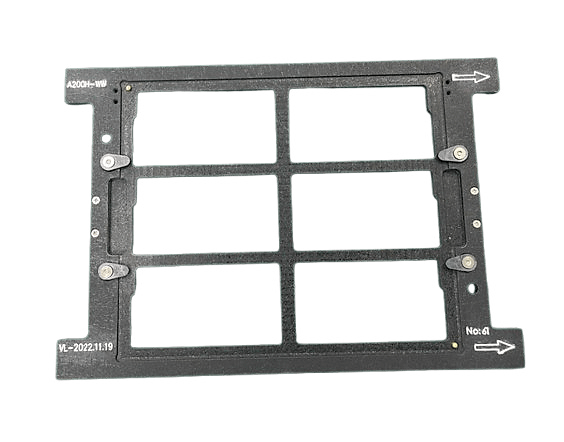
Wave soldering pallets
In wave soldering the underside of the board passes over a molten solder wave. The pallet exposes the through-hole leads to be soldered while masking everything else. Apertures are relatively large, and because the pallet face meets molten solder, material choice and chamfered aperture edges matter to avoid bridging and solder shadowing.
Selective soldering pallets
Selective soldering applies solder to targeted joints with a nozzle or mini-wave. Pallets have smaller, tighter apertures around specific joints and locate the board precisely for the nozzle path. Tolerances are tighter than in wave soldering, and the pallet often does more to shield neighbouring parts.
Material and design factors
Pallets are machined from heat-stable composite (Durostone-type) materials that take repeated thermal cycling without warping. The factors that decide whether a pallet stays repeatable:
- Heat-stable composite that resists warping across thermal cycles.
- Flatness and rigidity so the board locates the same way every time.
- Aperture design — chamfers and clearances tuned to wave or selective.
- Hold-downs and clips (often titanium) to keep the board seated.
- Masking of SMT components, connectors and gold-finger contacts.
When you need a custom pallet
Mixed-technology boards (SMT plus through-hole), boards with connectors or press-fit parts to protect, and any volume where repeatability and cycle stability matter. A pallet tuned to your board and process pays back in yield and fewer touch-ups.
How VILOOK TECH makes them
VILOOK TECH manufactures heat-stable soldering pallets, designed in CAD/3D and machined to spec for wave and selective soldering. See our soldering pallet product and mechanical engineering service, or send a project brief.